Medically Reviewed by (Dr Noor Aina binti Ahmad Nawawi)
Every wound tells a story. Whether it is a paper cut that stings for a moment or a surgical incision that takes weeks to close, your body responds with the same extraordinary sequence of wound healing stages.
Understanding how this process works, and what can go wrong, helps you care for yourself and those around you with a lot more confidence.
What Are the 4 Stages of Wound Healing?
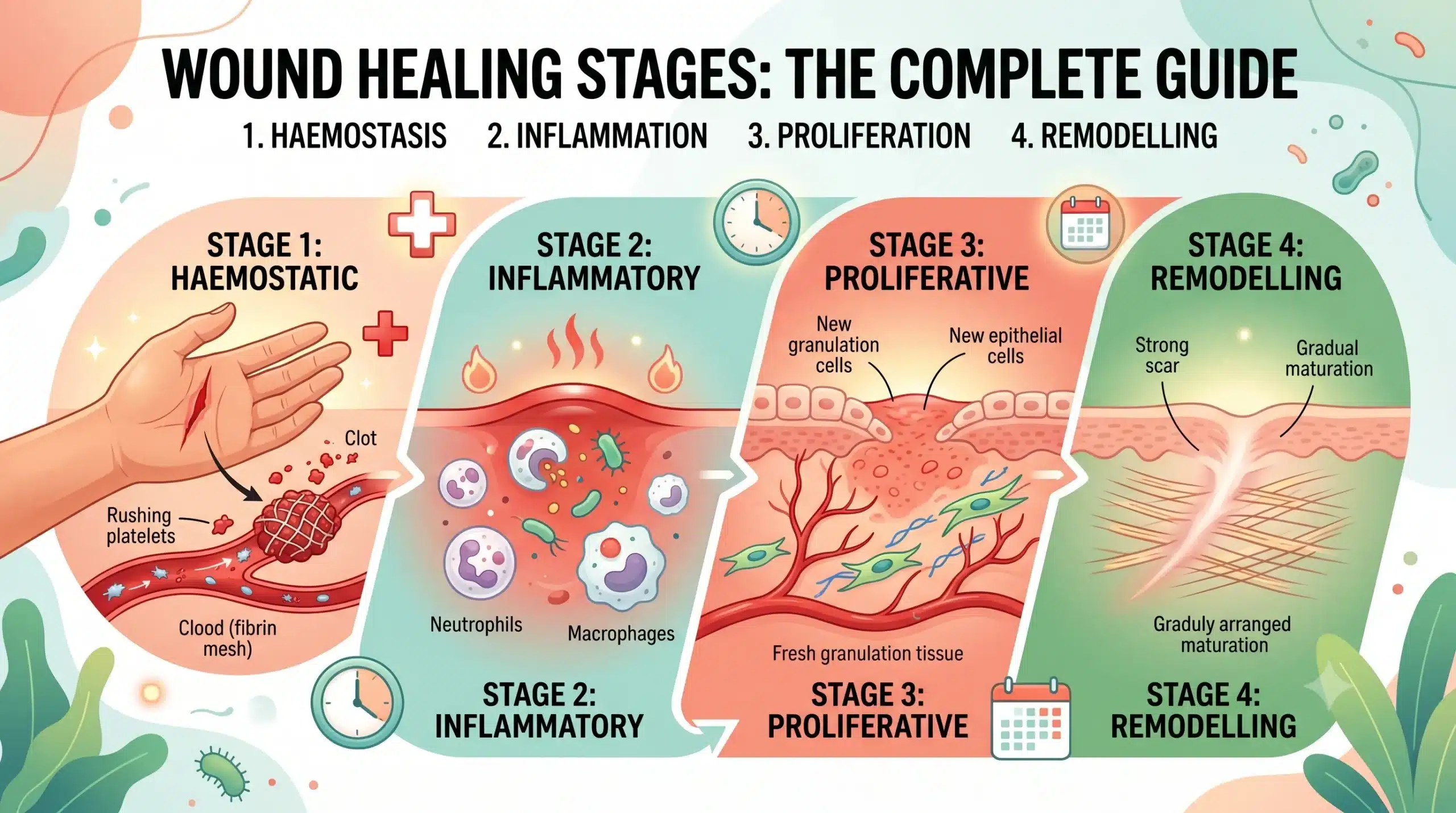
Wound healing is not a single event. It is a biological process that unfolds in four distinct but overlapping stages: haemostasis, inflammation, proliferation, and remodelling. Each stage has its own set of cellular actors, chemical signals, and structural goals. Together, they move a wound from open injury to closed, strengthened tissue.
These stages are not always tidy or perfectly sequential. They overlap, loop back on each other, and respond to external conditions.
Stage 1 of the Wound Healing Process Stages: Haemostasis
The moment a wound opens, the body’s first priority is simple and urgent: stop the bleeding. Haemostasis, which comes from the Greek words for blood and stopping, is the body’s emergency clotting response. Within seconds of injury, blood vessels constrict and platelets rush to the site, clumping together to form a temporary plug. A chain of proteins then triggers fibrin production, which weaves through the platelet plug to create a stable clot. The clot does two things: it controls blood loss and acts as an early scaffold on which future healing will be built [1].
Stage 2 of the Wound Healing Process Stages: Inflammation
Once the wound is sealed, the body shifts into its cleanup phase. Inflammation often gets a bad reputation, mostly because it looks and feels unpleasant. Redness, warmth, swelling, and tenderness around a wound are signs that your immune system is doing exactly what it should.
During inflammation, immune cells called neutrophils arrive first and begin clearing the wound of bacteria and debris. They are followed by macrophages, which are larger immune cells that continue the cleaning work and also release growth factors to signal the next phase of healing [2].
Stage 3 of the Wound Healing Process Stages: Proliferation
If haemostasis stops the bleeding and inflammation clears the damage, then proliferation is where the real rebuilding happens.
New blood vessels grow into the wound area through a process called angiogenesis, restoring the oxygen and nutrient supply that tissues need to survive. Cells called fibroblasts produce collagen, the structural protein that gives skin its strength and forms the basis of scar tissue. Specialised cells called myofibroblasts help pull the wound edges together. And across the surface, new epithelial cells migrate inward to close the wound from the outside in. This phase can last from a few days to several weeks depending on the size and depth of the wound. The new tissue that forms, often pink and slightly raised, is called granulation tissue, and its presence is a reliable sign that healing is on track [3].
Stage 4 of the Wound Healing Process Stages: Remodelling
The final stage of wound healing is perhaps the most underappreciated, partly because it happens mostly out of sight. Once the wound has closed, the body begins the long work of refining the scar tissue it has built. Collagen fibres that were laid down quickly during proliferation are gradually broken down and replaced with stronger fibres. This remodelling process can continue for up to two years after the initial injury. The scar tissue that results will never be quite the same as the original skin but it is functional, durable, and, for most people, barely noticeable with time [4].
Wound Healing Stages Timeline
Healing timelines vary considerably from person to person and wound to wound. That said, there are general windows that clinicians use to gauge whether recovery is progressing normally.
How Long Each Stage Usually Takes
As a general guide:
- Haemostasis: Minutes to hours after injury
- Inflammation: Days 1 to 6, though it can extend longer in complex wounds
- Proliferation: Approximately 4 to 24 days, depending on wound size
- Remodelling: 21 days to 2 years
A minor superficial cut might move through all four stages in a week or two. A deep surgical wound or a pressure ulcer might still be actively healing months later. Both of these can be entirely normal.
Factors That Affect Healing Speed
Wound healing speed is influenced by a web of biological, lifestyle, and environmental factors.
Age plays a significant role, with older adults generally healing more slowly due to reduced cellular activity and circulation.
Nutrition matters too, particularly adequate protein, vitamin C, and zinc, all of which are essential for collagen synthesis.
Wound location, depth, and whether there is any contamination also shift the timeline substantially.
Systemic conditions like diabetes, peripheral artery disease, and autoimmune disorders are among the most significant factors that slow healing at the physiological level.
When Healing Looks Normal and When It Does Not
Normal healing involves some discomfort in the early days, visible redness and swelling that gradually settles, and a wound that shrinks and closes over time. The skin around it may itch as new tissue forms, which, while annoying, is actually a positive sign.
Healing that is not progressing normally might look like persistent swelling, increasing pain after the first few days, pus or foul-smelling discharge, or wound edges that are separating rather than coming together. Any of these warrant medical attention.
Signs That the Wound Healing Process Stages Are Progressing Well
Knowing what good healing looks like is just as important as knowing the warning signs. Here is what you would expect to see as each stage completes its work.
Reduced Redness and Swelling
As the inflammatory phase resolves, typically within the first week, the skin around the wound should begin to look less angry. Redness fades, swelling decreases, and the area feels cooler to the touch. Pain at rest should reduce noticeably.
New Tissue Formation
During the proliferation phase, the wound bed may appear red or pink and slightly bumpy. This is healthy granulation tissue, rich in new blood vessels and collagen. It should look moist, not dry or necrotic. In superficial wounds, a thin layer of new skin, often slightly shiny and lighter in colour than the surrounding tissue, will begin to migrate across the surface from the wound edges inward.
Skin Closure and Strengthening
A wound that is progressing well will gradually close and the surrounding skin will regain its normal texture and colour. Sutures, if present, can typically be removed once the wound edges have adequately fused, usually between five and fourteen days depending on the wound site. Even after closure, the remodelling process continues internally.
Factors That Can Slow the Stages of Wound Healing
Even with the best biological programming in place, healing does not always go smoothly. A range of factors, both local and systemic, can delay or disrupt the process at any stage.
Infection
When bacteria colonise a wound beyond the body’s capacity to manage them, infection sets in and the inflammatory phase cannot resolve. The immune system becomes locked in a defensive battle instead of transitioning to repair. Signs of infection include increasing pain, warmth, redness spreading beyond the wound edges, swelling, and purulent discharge. Untreated wound infections can spread to surrounding tissue (cellulitis) or, in severe cases, enter the bloodstream (sepsis). Prompt medical treatment with appropriate wound care and, where indicated, antibiotics is essential [9].
Poor Blood Flow
Healing tissue is hungry tissue. It needs a constant supply of oxygen, nutrients, and immune cells, all of which are delivered through the bloodstream. When circulation is compromised, whether due to peripheral artery disease, venous insufficiency, or other vascular conditions, wounds in the extremities can struggle to heal [2].
Diabetes and Chronic Conditions
Diabetes affects wound healing through several compounding mechanisms. Elevated blood glucose impairs the function of immune cells, reduces collagen synthesis, damages peripheral nerves, and compromises vascular health. People living with diabetes are significantly more likely to develop chronic, non-healing wounds and to experience serious complications, including infection and amputation. Other chronic conditions such as autoimmune diseases, chronic kidney disease, and obesity also impair the normal healing process in various ways [6].
Smoking and Nutrition
Smoking reduces oxygen delivery to tissue by constricting blood vessels and replacing oxygen in the bloodstream with carbon monoxide. Studies consistently show that smokers have higher rates of wound complications and longer healing times than non-smokers.
Nutritional deficiencies, particularly in protein, vitamin C, and zinc, directly impair the body’s ability to synthesise collagen and mount an effective immune response. Malnutrition, even when it is not clinically obvious, is one of the most commonly overlooked contributors to poor wound healing in both community and hospital settings [7].
When to See a Doctor for Poor Healing
Most minor wounds heal without any medical intervention. But there are clear situations where waiting and watching is no longer the right approach.
Signs of Infection
Seek medical attention if you notice any of the following:
- Redness spreading beyond the wound edges, particularly if it is tracking outward in streaks
- Yellow or green discharge, particularly if it is foul-smelling
- Increasing pain or heat at the wound site after the first few days
- Fever, chills, or feeling generally unwell
These symptoms suggest infection is present and may require wound debridement, swab culture, and antibiotic therapy.
Wounds That Do Not Improve
A wound that has not shown measurable improvement in size, depth, or appearance after two to four weeks should be evaluated by a healthcare professional. Chronic wounds affect millions of people globally and require specialised assessment. The cause of the stalled healing must be identified and addressed before the wound itself can progress [8].
Deep or Severe Wounds
Any wound that is deep enough to expose fat, muscle, or bone requires immediate medical attention. The same applies to wounds with edges that cannot be brought together easily, wounds caused by bites (human or animal), puncture wounds, wounds with embedded foreign objects, or any wound in a person with a known condition that impairs healing. Burns that are larger than the palm of your hand, or any burn on the face, hands, feet, or genitals, should also be seen urgently.
The same principle applies after any medical procedure — for example, our guide on what to expect after a gastric balloon procedure explains which post-procedure symptoms are normal and which warrant a call to your care team.
Get Professional Treatment for Wounds That Do Not Heal Properly
The body is remarkably capable. But it cannot always do this work alone, particularly when underlying conditions, infection, or other complications have entered the picture. If a wound is not healing as expected, seeking specialist care is not an overreaction.
At ACC, our wound care specialists offer evidence-based assessment and treatment for a wide range of acute and chronic wounds. Whether you are managing a post-surgical wound, a diabetic foot ulcer, or a wound that simply refuses to close, we are here to help you understand what is happening and to put the right treatment plan in place.
Do not leave a non-healing wound to chance. Book a consultation with our team today and take the first step toward proper healing.
References
[1] Singer, A.J. and Clark, R.A.F. (1999) ‘Cutaneous wound healing’, New England Journal of Medicine, 341(10), pp. 738–746.
[2] Eming, S.A., Martin, P. and Tomic-Canic, M. (2014) ‘Wound repair and regeneration: mechanisms, signaling, and translation’, Science Translational Medicine, 6(265), p. 265sr6.
[3] Velnar, T., Bailey, T. and Smrkolj, V. (2009) ‘The wound healing process: an overview of the cellular and molecular mechanisms’, Journal of International Medical Research, 37(5), pp. 1528–1542.
[4] Gurtner, G.C., Werner, S., Barrandon, Y. and Longaker, M.T. (2008) ‘Wound repair and regeneration’, Nature, 453(7193), pp. 314–321.
[5] Broughton, G., Janis, J.E. and Attinger, C.E. (2006) ‘The basic science of wound healing’, Plastic and Reconstructive Surgery, 117(7 Suppl), pp. 12S–34S.
[6] Brem, H. and Tomic-Canic, M. (2007) ‘Cellular and molecular basis of wound healing in diabetes’, Journal of Clinical Investigation, 117(5), pp. 1219–1222.
[7] Stadelmann, W.K., Digenis, A.G. and Tobin, G.R. (1998) ‘Impediments to wound healing’, American Journal of Surgery, 176(2A Suppl), pp. 39S–47S.
[8] Lazarus, G.S., Cooper, D.M., Knighton, D.R., Margolis, D.J., Pecoraro, R.E., Rodeheaver, G. and Robson, M.C. (1994) ‘Definitions and guidelines for assessment of wounds and evaluation of healing’, Archives of Dermatology, 130(4), pp. 489–493.
[9] Wounds International (2016) International wound infection institute (IWII) wound infection in clinical practice. London: Wounds International.