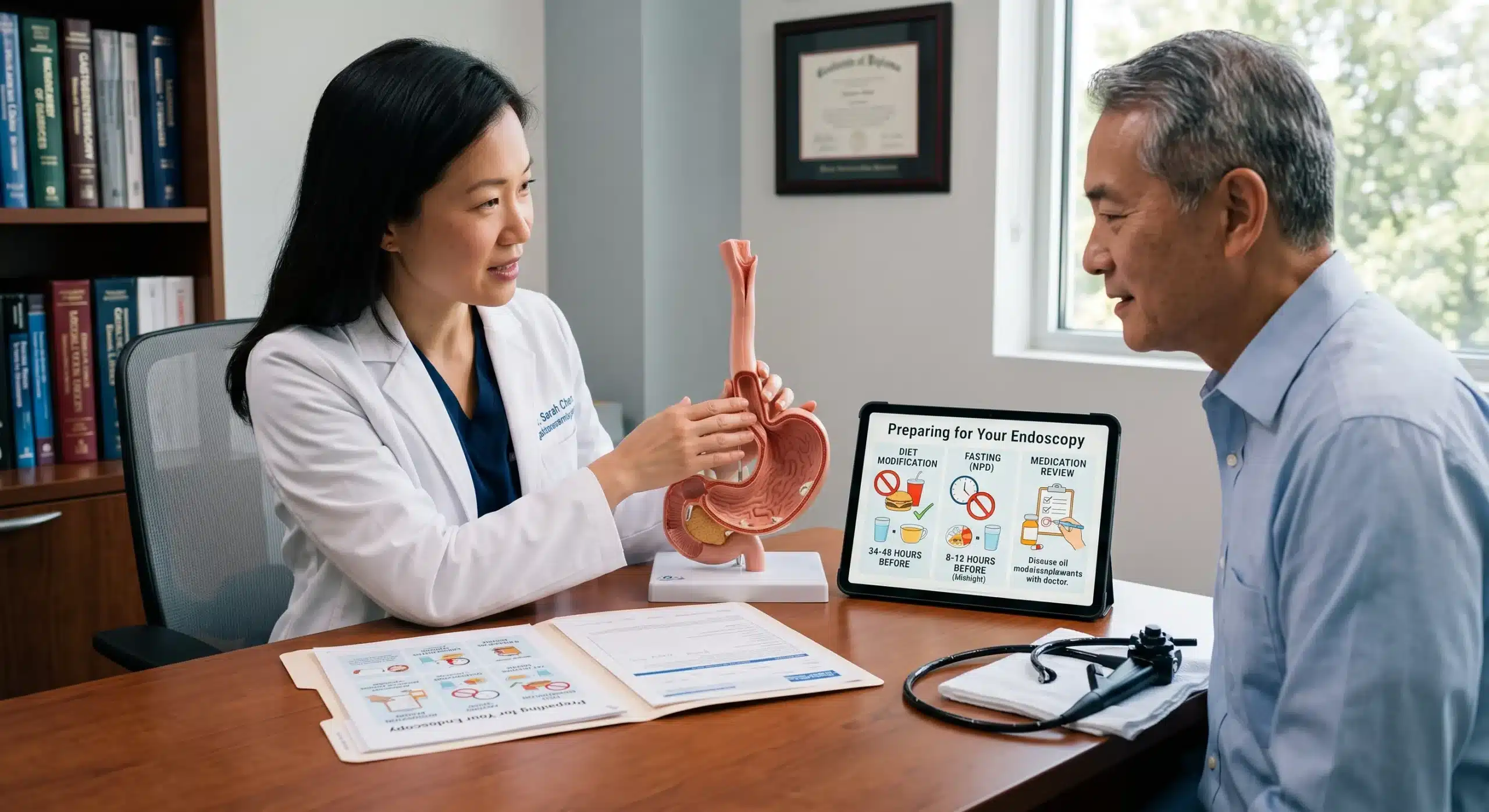
If your gastroenterologist has scheduled you for an upper gastrointestinal endoscopy (also known as a gastroscopy), you are taking a crucial step in safeguarding your digestive health.
While the idea of a medical instrument examining your stomach can cause natural anxiety, understanding the preparation process is the best way to ease your mind.
The success and safety of your stomach examination rely entirely on how well you prepare. A clear, completely empty stomach is non-negotiable—it allows your doctor to accurately visualise your digestive tract, take necessary biopsies, and ensure you remain safe while under sedation.
Whether you are navigating the strict fasting protocols or planning exactly what to eat after endoscopy, this definitive guide covers everything you need to know for a smooth, stress-free procedure.
Why Do Doctors Prefer Endoscopy Over Other Tests?
Doctors consider an upper endoscopy the gold standard for diagnosing gastrointestinal issues because it provides a direct, high-definition, and real-time view of the esophageal, stomach, and duodenal lining.
Unlike non-invasive imaging tests such as X-rays, CT scans, or MRIs, an endoscopy offers a dual benefit: it is both diagnostic and therapeutic.
If a gastroenterologist spots active bleeding, severe inflammation, polyps, or suspicious tissues, they can immediately stop the bleeding or extract a biopsy (tissue sample) during the very same procedure.
How to Prepare for an Endoscopy: Step-by-Step Instructions
Proper preparation begins several days before your appointment. To ensure your safety and the accuracy of the test, follow these essential steps:
What Should You Not Do Before an Endoscopy?
- Do not ignore medication adjustments: Always inform your doctor about every medication, supplement, and over-the-counter drug you take, as you may need to temporarily stop blood thinners or adjust diabetes medications based on clinical advice [2].
- Do not consume red or purple liquids: In the days leading up to the procedure, avoid liquids containing red or purple dyes. These can temporarily stain the stomach lining and mimic the appearance of internal bleeding, leading to an inaccurate diagnosis.
- Do not smoke or chew gum: Avoid smoking and chewing gum on the morning of your procedure. Both activities can stimulate stomach acid production, which introduces unnecessary fluids into an otherwise empty stomach.
How Many Hours Should I Empty My Stomach Before an Endoscopy?
The most critical aspect of your preparation is the fasting schedule. The risk of aspiration—where stomach contents travel into the lungs while you are sedated—is a severe medical emergency.
To prevent this, you must stop eating all solid foods completely for at least 8 hours before your scheduled endoscopy [2].
If your procedure is scheduled for the morning, this strictly means you should have nothing to eat after midnight.
Up until 2 hours before your procedure, you are typically permitted to drink specific “clear liquids” to stay hydrated, such as water, plain black coffee (without milk), or clear broths [2]. Exactly two hours prior to your appointment time, you must stop drinking all liquids entirely [2].
What to Expect During the Procedure
For a full walkthrough of what happens once you’re in the procedure room, see our step-by-step guide to how an endoscopy is performed.
Do They Fully Put You to Sleep for an Endoscopy?
For most standard endoscopic examinations, patients are not put fully to sleep using general anesthesia (which requires a breathing tube). Instead, you will receive “conscious sedation” (or moderate sedation) administered intravenously [1].
This specialised sedation induces a state of deep relaxation and drowsiness, though you are technically still breathing on your own.
Due to the amnesic effect of the medication, the vast majority of patients fall into a light sleep and wake up with absolutely no memory of the procedure itself [1].
Is Endoscopy Painful All the Time?
No, an endoscopy is very rarely painful. The internal lining of your gastrointestinal tract lacks the same pain receptors found on your external skin, meaning you will not feel sharp or cutting sensations.
To further maximise comfort, the medical staff will use a local anesthetic spray to numb the back of your throat, completely neutralising the gag reflex so the endoscope can pass smoothly [1].
During the 10-to-15-minute examination, you may feel mild pressure or bloating from the air gently pumped into your stomach to expand the viewing area, but it is not designed to be a painful experience.
Which One is More Painful: Colonoscopy or Endoscopy?
Clinically, neither procedure should be painful because both utilise effective sedation to keep you comfortable.
However, patients frequently report that the preparation phase for a colonoscopy—which involves drinking high volumes of strong laxatives to induce bowel clearing—is significantly more uncomfortable than an endoscopy, which simply requires a standard period of fasting.
(Note: If you are undergoing a colonoscopy, your privates are always covered with a specialised medical gown to maintain your privacy and dignity).
Post-Procedure Guidelines: Recovery and Diet
Can I Walk Home After an Endoscopy?
No, you are not legally or safely permitted to walk or drive yourself home. Because you receive intravenous sedation to keep you comfortable, your reflexes, physical balance, and judgment will be significantly impaired for the rest of the day, meaning you must arrange for a trusted family member or friend to drive you home safely [2].
How Long is Recovery After Endoscopy?
Your immediate recovery will take place in the clinic’s recovery room, typically lasting 30 to 60 minutes while the initial grogginess wears off and your vital signs are monitored.
However, it takes a full 24 hours for the sedative medications to completely leave your bloodstream.
During this 24-hour window, you must rest at home and strictly avoid operating heavy machinery, returning to work, or making important legal or financial decisions.
What to Eat After Endoscopy? Diet Guidelines
Because your throat was numbed with an anesthetic spray, you must wait until your swallowing reflex has completely returned to normal—usually within an hour—before attempting to eat or drink. Starting too soon can increase the risk of choking.
The First 24 Hours: The Soft Food Phase Your stomach has been empty for a long period, and the slight inflation during the procedure might leave you feeling bloated. Transition back to eating with gentle, highly digestible foods:
- Clear, Cool Liquids: Start with small sips of water, diluted non-citrus juices (like apple juice), or warm herbal tea [3].
- Porridge or Congee: A highly recommended, soothing option that is incredibly gentle on an empty digestive tract [3].
- Soups and Broths: Opt for smooth, clear soups without heavy creams or large chunks of tough meat [3].
- Soft Proteins: Scrambled or soft-boiled eggs are excellent sources of easy-to-digest protein [3].
- Mashed Fruits and Vegetables: Applesauce, mashed bananas, or mashed potatoes [3].
Foods and Drinks to Strictly Avoid For the first 24 to 48 hours post-procedure, you must protect your healing digestive tract by actively avoiding:
- Spicy and Acidic Foods: Chillies, heavy curries, tomatoes, and citrus fruits will irritate the stomach lining [3].
- Greasy, Fried, or Highly Processed Foods: These require excessive stomach acid to digest and can trigger severe nausea after sedation [3].
- Alcohol: You must consume absolutely no alcohol for at least 24 hours, as it interacts dangerously with the lingering sedatives in your central nervous system [1].
Prioritise Your Digestive Health Today
Gastrointestinal conditions and colorectal issues are among the most critical health concerns in Malaysia. Taking proactive steps to monitor your digestive health through timely, professional screenings can lead to early detection and vastly improved treatment outcomes.
At ACC Evesuite Medical Centre, located in Ara Damansara, we prioritise your comfort and safety. Our ambulatory care centre features a fully equipped procedure room and a team of highly experienced specialists dedicated to providing seamless, comprehensive gastrointestinal screenings.
Do not let fear or uncertainty delay your healthcare. Take control of your wellbeing today.
Visit ACC Evesuite Medical Centre – Gastroscopy and Colonoscopy to learn more about our specialised services or to book your consultation with our expert team.
References
American Society for Gastrointestinal Endoscopy (ASGE) (2014). Understanding Upper Endoscopy. Patient Education Guidelines. Available at: https://www.giejournal.org/ (Accessed: 1 July 2026).
National Health Service (NHS) (2021). Endoscopy – How to Prepare. NHS Health Information. Available at: https://www.nhs.uk/conditions/endoscopy/ (Accessed: 1 July 2026).
World Gastroenterology Organisation (WGO) (2016). Diet and the Gut. Global Guidelines. Available at: https://www.worldgastroenterology.org/guidelines/diet-and-the-gut (Accessed: 1 July 2026).
Medically reviewed by
Dr Yap Huey Yin
MD (I.M. Sechenov Moscow Medical Academy)
Dr Yap Huey Yin is a general practitioner with experience in primary care, general medicine and health screening. She currently practises at Qualitas Health Klinik Catterall, Khoo & Raja Malek in Petaling Jaya, providing a range of general medical and preventive healthcare services.
Our medical reviewers are part of Qualitas Health Group, of which ACC is a member through Qualitas Health Malaysia.