When you are exploring medical paths to manage your weight, the most pressing question on your mind is usually practical: How much weight can I actually expect to lose, and what does the real day-to-day journey look like?
If you are trying to break through a stubborn weight plateau, the idea of traditional bariatric surgery can feel too invasive, while relying solely on standard diet and exercise may have left you feeling stuck. Intragastric balloon therapy has emerged as a highly sought-after, non-surgical intervention. It bridges the gap between lifestyle modifications and permanent surgery.
To give you the most accurate expectations, we look past marketing claims and rely straight on recent multi-center clinical trials, systematic reviews, and high-authority medical data. Let’s look at an exhaustive breakdown of gastric balloon weight loss results, real-world timelines, and the complete medical journey from preparation to long-term success.
Read: What is a Gastric Balloon? How This Non-Surgical Procedure Helps You Lose Weight
Quick Answer: Average Weight Loss Metrics
On average, patients undergoing a structured intragastric balloon programme lose between 10% to 15% of their total body weight within the first 3-6 months.
To translate this percentage into real-world numbers on the scale:
- If your starting weight is 90 kg, a 10% to 15% reduction means losing 9 kg to 13.5 kg.
- If your starting weight is 110 kg, you can realistically expect to lose 11 kg to 16.5 kg.
A landmark 2025 systematic review and meta-analysis of randomized controlled trials (RCTs) evaluating 1,961 patients confirmed that a gastric balloon achieves significantly superior absolute weight loss and body mass index (BMI) reduction at 6, 9, and 12 months compared to standard medical lifestyle therapies alone.

The Clinical Timeline of Gastric Balloon Weight Loss Results
Weight loss with an intragastric device is a dynamic journey. Your body goes through specific biological phases as it adapts to the balloon and shifts its metabolic habits.
Phase 1 (Weeks 1 to 4): The Rapid Drop & Adaptation Phase
The most rapid drop on the scale typically occurs during the first 2 to 4 weeks. During the initial 3 to 7 days, your stomach goes through an “accommodation phase” where its smooth muscles contract as they adapt to the physical presence of the balloon. Because you will follow a specialist-guided clear liquid and pureed diet during this time, weight loss begins immediately.
Phase 2 (Months 2 to 6): Consistent Fat Loss & Satiety Training
Once your stomach accepts the device, your weight reduction transitions into a steady, sustainable pace. A high-authority 2025 clinical evaluation tracking device efficacy showed that patients lose an average of 13.51% of their initial body weight by the time the balloon treatment period concludes.
During this phase, the balloon acts as an intuitive portion control aid by physically taking up space in the gastric cavity, forcing a natural delay in gastric emptying.
Phase 3 (Post-Removal & Beyond): Long-Term Weight Maintenance
A common concern is whether the weight returns once the balloon is removed. Exciting data from a 2025 international multicenter study tracking 522 patients across 9 obesity centers revealed that patients maintained a 95% weight loss maintenance rate one full year after the balloon left their body.
This proves that when the procedure is backed by digital tracking tools and consistent behavioral coaching, the lifestyle changes stick for the long haul.
Clinical Candidacy: Who Is the Intragastric Balloon For?
Eligibility and BMI Thresholds
According to international clinical indication benchmarks for non-surgical weight loss, you are an ideal candidate for a gastric balloon if your Body Mass Index (BMI) is 27 or higher.
It is designed specifically for individuals who have hit a stubborn plateau with traditional dieting, are classified as overweight or Class I obese, and want a safe, proactive intervention to protect their metabolic health before severe complications develop.
Contraindications: Who Shouldn’t Have a Gastric Balloon?
While the balloon is incredibly safe, it is not medically suitable for everyone. For your physical safety, a gastric balloon cannot be placed if you have:
- A history of major gastric or esophageal surgeries (such as anti-reflux surgery or a gastric bypass).
- Large hiatal hernias, active stomach ulcers, or severe inflammatory gastrointestinal diseases.
- Conditions that require a continuous regimen of blood thinners or high-dose anti-inflammatory medications.
- Active pregnancy or a history of untreated eating disorders.
Read: Is It Safe? Understanding Gastric Balloon Side Effects and What to Expect Post-Procedure
Step-by-Step Medical Journey: What Happens Before, During, and After
To lower any post-procedure anxiety, it helps to understand that the endoscopic balloon process is treated as a highly standardized, outpatient day-care sequence.
1. Pre-Procedure Preparation (What Happens Before)
In the weeks leading up to your placement, you will undergo a comprehensive health screening to clear your stomach anatomy. Our medical team will guide you through simple dietary shifts. You will be asked to fast from solid foods for 12 to 24 hours and stop drinking liquids roughly 6 hours before arriving at our centre to ensure your stomach is completely empty and ready.
For a full breakdown of dietary preparation and recovery, see our complete pre-procedure fasting and preparation guide.
2. Day of Placement: The Endoscopic Insertion (What Happens During)
When you arrive at our accredited endoscopy suite, you will be given mild comfort sedation. You will be completely relaxed and sleepy, feeling no physical pain — this is the sedation experience many patients describe as comfortable, with most waking up afterward with no memory of the procedure.
- Insertion: An experienced specialist gently guides a thin, flexible tube with a tiny camera (an endoscope) through your mouth and down into your stomach.
- Inflation: The specialist passes the deflated, medical-grade silicone balloon into place and expands it using a sterile solution or air.
- Timing: The entire process takes a swift 20 to 30 minutes. Once completed, you will move to a comfortable Daycare Bed for a brief monitoring window before being safely discharged home the exact same day.
3. The First Week: Navigating the Accommodation Phase
As your stomach smooth muscles contract against the volume of the balloon, experiencing temporary symptoms is a completely natural biological milestone. Over the first 3 to 7 days, monitored clinical trials tracking post-sedation adjustments indicate that patients frequently experience temporary nausea, fluid regurgitation, or localized abdominal cramping.
To ensure your physical peace of mind, our specialists prescribe a targeted medical regimen consisting of anti-nausea medications (antiemetics) and stomach relaxants to completely minimize this initial discomfort.
4. The Extraction Process: What Happens When the Balloon Comes Out?
Depending on your customized treatment plan (typically at the 6 or 12-month mark), the balloon has completed its training job.
Under the same mild comfort sedation, a specialist introduces an endoscope, safely punctures and deflates the balloon, collects the fluid, and removes the soft silicone shell back out through the mouth.
Your stomach anatomy remains 100% intact, functioning completely naturally.
Scientific Risks vs. Long-Term Health Benefits
Real Neurohormonal & Metabolic Benefits
The balloon does far more than just mechanically block space. Broad-scale systematic registries in bariatric research explain that mechanical gastric distension continuously stimulates stretch receptors in your stomach wall. This action triggers neurohormonal signals—including the suppression of ghrelin (the hunger hormone)—which effectively quietens down “food noise” in your brain and stops the urge to overeat.
Furthermore, reducing your weight by 10% to 15% drives significant clinical drops in HbA1c (blood sugar levels) and blood pressure, protecting your long-term cardiovascular health.
Clinical Risks and Deflation Safety
While modern, medical-grade silicone devices are incredibly durable, balloon deflation is a rare possibility tracked by global registries (<1% to 2% of cases). To ensure absolute safety, balloons are typically filled with a biocompatible blue dye. In the unlikely event of a micro-leak, the dye turns your urine green, serving as an immediate visual signal for our NSR-certified specialists to safely retrieve the device endoscopically before it can cause an intestinal blockage.
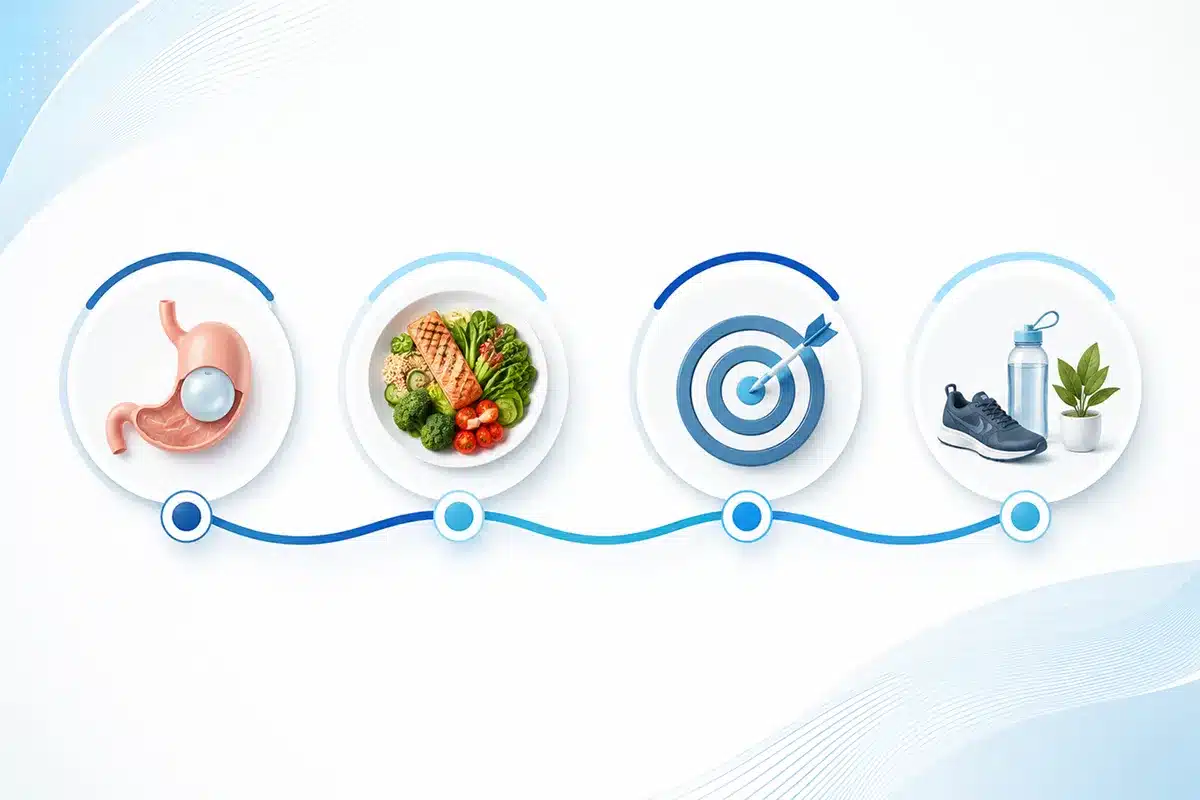
Maximizing Your Results: The ACC Shape Journey Difference
The true secret to keeping the weight off for years after the balloon is removed lies in the clinical ecosystem surrounding your procedure. At ACC Evesuite, we maintain an outstanding 4.6 out of 5.0 rating based on more than 100 patient reviews, highlighting our dedication to patient safety and supportive long-term care.
We ensure your gastric balloon weight loss is sustainable by fully integrating your treatment into the ACC Shape Journey—a comprehensive program led by National Specialist Register (NSR) certified weight loss specialists:
- Premium Adjustable Technology: We utilize advanced, premium adjustable balloon systems. If your initial accommodation phase is highly sensitive, or if your weight loss hits a natural plateau around Month 4, our specialists can comfortably scale the balloon’s internal volume endoscopically to maximize your physical comfort and reactivate your satiety signals.
- Personalized Lifestyle Coaching: You are never left to navigate nutrition alone. Our expert dietitians work beside you throughout your treatment to help you effortlessly transition from liquids to healthy solid foods, building intuitive portion habits.
- Appetite Management Support: From targeted pre-procedure health screenings to medically supervised appetite management therapies and non-invasive body contouring treatments like Mesolipolysis, we support your health transformation from every angle.
Frequently Asked Questions (FAQ)
1. How long do the weight loss results last after removal?
Because the balloon acts as a physical training aid, it helps you reshape your dietary behaviors over 6 to 12 months. Clinical studies demonstrate a 95% weight loss maintenance rate a year after removal when patients continue to follow the intuitive portion habits and lifestyle modifications established during their clinical coaching program.
2. Can a gastric balloon stretch out my stomach permanently?
No. The stomach is a highly elastic muscle. While it stretches temporarily to hold the balloon, it naturally returns to its baseline anatomical size and shape within a few weeks after the deflated device is safely removed.
3. How much downtime do I need to take off from work?
Because the insertion is entirely non-surgical and takes only 20 minutes in our day-care center, recovery is rapid. Most patients choose to have their balloon placed on a Friday morning, rest comfortably over the weekend during the initial adjustment phase, and confidently return to normal office work by Monday.
Are you ready to discover how a customized, non-surgical approach can transform your health? Contact ACC Evesuite today to schedule your personalized consultation with our medical specialists.
Disclaimer: The information provided in this article is for educational purposes only and should not replace professional medical advice. Always consult with a qualified healthcare provider regarding any medical conditions or weight loss treatments.
References
Wiggins, T., Sharma, O., Sarfaraz, Y., Fry, H., Baker, J. and Singhal, R. (2023). Safety and Efficacy of 12-Month Intra-gastric Balloon—Series of over 1100 Patients. Obesity Surgery. doi:https://doi.org/10.1007/s11695-023-06953-0.
Amaral, G. de O., Schmitt, J.P., Delgado, L.M. and Meine, G.C. (2025). Intragastric balloon for obesity treatment: Systematic review and meta-analysis of randomized controlled trials. Endoscopy International Open, 13(CP). doi:https://doi.org/10.1055/a-2681-2859.
Caballero, A., Giardiello, C., Schiano, R., Rosa, M., Juneja, G., Pagan, A., Murcia, S., Formiga, A., Freda, A. and Ienca, R. (2025). Weight Loss Maintenance 1 Year after the Swallowable Gastric Balloon: Results from an International Multicenter Study. Obesity Surgery, [online] 35(9), pp.3591–3598. doi:https://doi.org/10.1007/s11695-025-08074-2.
Berhuni, M.S., Elkan, H., Yüksekyayla, B. and Kaplan, V. (2025). Efficacy of Intragastric Balloon Treatment: Outcomes and Patient Satisfaction 6 Months After Removal. Medicina, 61(4), p.616. doi:https://doi.org/10.3390/medicina61040616.
Marek Bužga, Machytka Evžen, Pavel, K., Kupka Tomáš, Zavadilová Vladislava, Pavel, Z. and Zdeněk Švagera (2014). Effects of the Intragastric Balloon MedSil® on Weight Loss, Fat Tissue, Lipid Metabolism, and Hormones Involved in Energy Balance. Obesity Surgery, 24(6), pp.909–915. doi:https://doi.org/10.1007/s11695-014-1191-4.
Ameen, S. and Merchant, H.A. (2024). Intragastric balloons for obesity: critical review of device design, efficacy, tolerability, and unmet clinical needs. Expert Review of Medical Devices, [online] 21(1-2), pp.37–54. doi:https://doi.org/10.1080/17434440.2023.2289691.
Crossan, K. and Sheer, A.J. (2022). Intragastric Balloon. [online] PubMed. Available at: https://www.ncbi.nlm.nih.gov/books/NBK578184/.
Medically reviewed by
Dr Ruthresh Rao Subramanyan
MBBS (UniSZA), MPH (Distinction) (University of Malaya)
Dr Ruthresh Rao Subramanyan currently serves as Senior Manager (Medical Services) at Qualitas Medical Group, where he leads clinical governance, clinical development, continuing medical education and regulatory affairs across the organisation’s network of more than 100 doctors. He has a background in public health, occupational health and healthcare leadership, with previous roles at the National Cancer Society Malaysia and Malaysia’s Crisis Preparedness and Response Centre (CPRC). He holds an MBBS from UniSZA, a Master of Public Health (Distinction) from the University of Malaya, and postgraduate studies in Medical Law & Practice.
Our medical reviewers are part of Qualitas Health Group, of which ACC is a member through Qualitas Health Malaysia.